
2025-2026 Guide to Custom Medal Design: Materials, Finishes & Techniques
Choosing the right custom medal involves careful consideration of materials, processes, and color schemes. This guide walks you through key factors to ensure a high-quality result that meets your expectations.
1,What Is a Custom Medal?
Custom medals are made for a specific event, organization, or occasion. Rather than choosing from standard medal designs, customers can decide on the shape, size, material, colors, and details that best represent their event or brand.
For example, marathon organizers often want medals that reflect the race route, local landmarks, or the theme of the event. Schools and universities may prefer their logos, anniversary dates, or mottos on the medals. For corporate recognition programs, a more refined metal finish and carefully designed packaging can make the award feel more special.
At Yuehui Gifts, we work with different types of custom medal designs, from simple 2D logos to detailed 3D relief featuring buildings, athletes, and other complex elements. Some customers come to us with production-ready artwork, while others only have a rough sketch or an idea that needs to be developed.
The material and manufacturing process are selected based on the actual design. A small, flat medal with a simple logo may require a different production method from a large, three-dimensional medal with cut-out sections or detailed enamel colors. We usually review these details before making the mold, so customers have a clear understanding of what can be achieved.
2,Material Selection: Choose the Right Base
The material forms the foundation of your medal’s look and durability.
Copper: Ideal for high-end medals. When electroplated, it offers brilliant shine and sharp detail. Recommended if budget allows.
· Zinc Alloy: A cost-effective alternative that still supports complex shapes and fine features. Great for detailed designs without the premium cost.
· Iron: Prone to rusting. Only consider it for antique or vintage-style medals where a weathered look is intentional.
3, From a Hand-Drawn Sketch to a Finished Custom Medal
You don’t need professional artwork to get started on a custom medal.
Some customers send us detailed design files. Others send a pencil sketch, a photograph, or a few notes explaining what they have in mind. Both are perfectly fine.
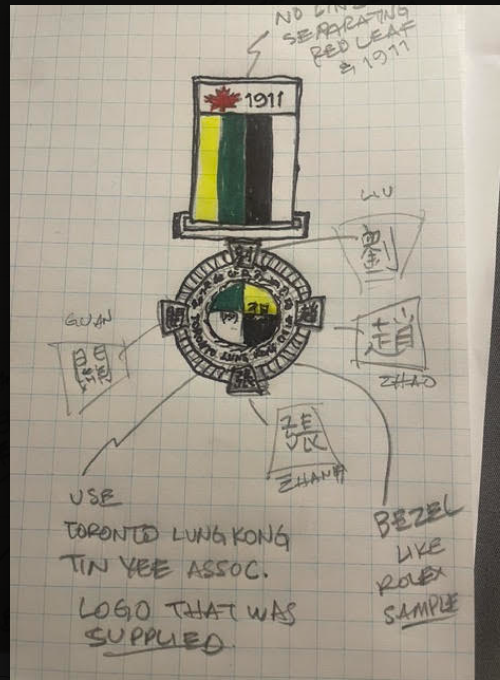
One project we worked on started with a hand-drawn sketch for the Toronto Lung Kong Tin Yee Association. The customer had a clear idea of what they wanted: a traditional circular medal, Chinese characters around the centre, a four-colour ribbon, and a small bar at the top featuring a maple leaf and the year 1911.
The sketch wasn’t a finished design, but it gave us enough to work with.
1. Starting with the Customer's Sketch
The first image shows the original drawing we received.
It was drawn on graph paper, with handwritten notes pointing out the main details. The customer had already marked the ribbon colours, the position of the lettering, and the overall shape of the medal.
Our first job was to understand which details were essential to the customer and how they could be reproduced in metal.
A sketch doesn’t have to be perfect. What matters is that we understand what you’re trying to create.
Image caption: The customer’s original hand-drawn sketch, showing the medal layout, ribbon colours and lettering.
2. Turning the Sketch into a Workable Design
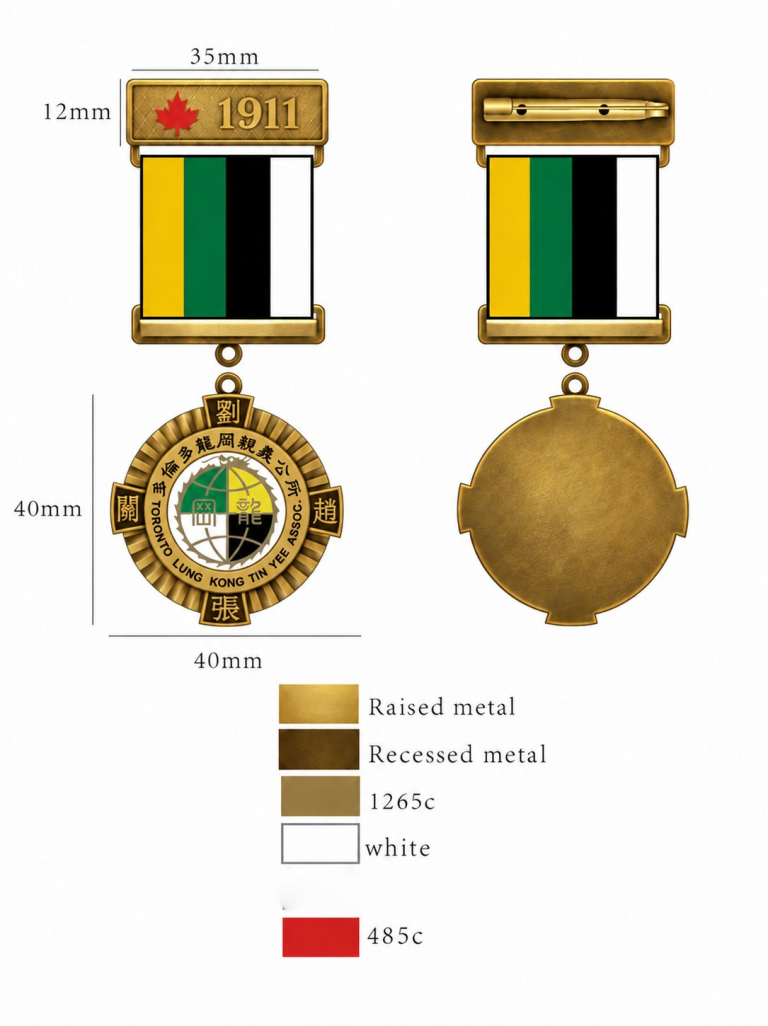
Using the original sketch as a reference, we developed a more detailed digital design.
AI-assisted visuals can help us explore the appearance of a medal during the early design stage. We then check the dimensions, lettering, colour areas and metal details before preparing the artwork for production.
For this particular medal, the main circular section was designed at approximately 40 mm, with a 35 mm-wide upper bar. The artwork also included the front and back views, making it easier to review the construction before tooling.
This is where we usually make small adjustments. Lettering that looks fine on paper may need more space, and some details may need to be slightly raised or simplified to reproduce clearly in metal.
We share the revised design with the customer for approval before moving ahead.
Image caption: The digital design showing the medal dimensions, enamel colours, metal finish and front and back views.
3. Making the Metal Mold
nce the design is approved, we move on to tooling.
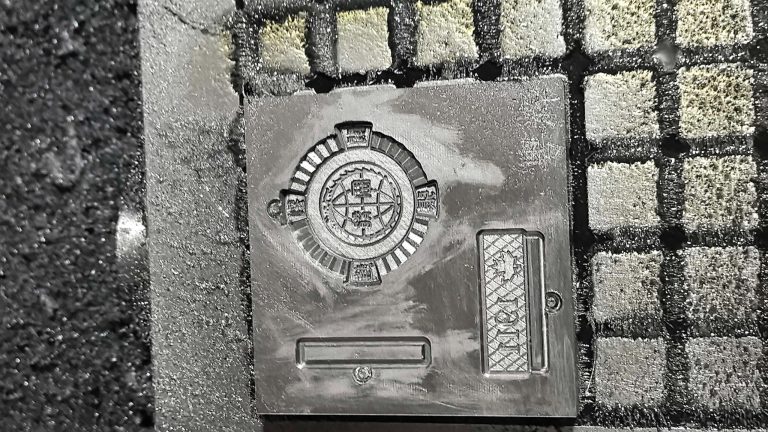
The third photo shows the metal mold used to produce the medal components. The shapes, lettering and decorative details are formed into the tooling so they can be reproduced during production.
This is why we take the artwork review seriously. Making changes to a digital drawing is relatively straightforward. Changing a finished mold can be much more complicated and may involve additional costs.
Before making the mold, we check the size of the lettering, the depth of the relief, the metal borders and the areas where enamel will be applied.
Image caption: The production mold, showing the detailed relief and lettering used to form the metal medal.
4. Checking the Finished Sample
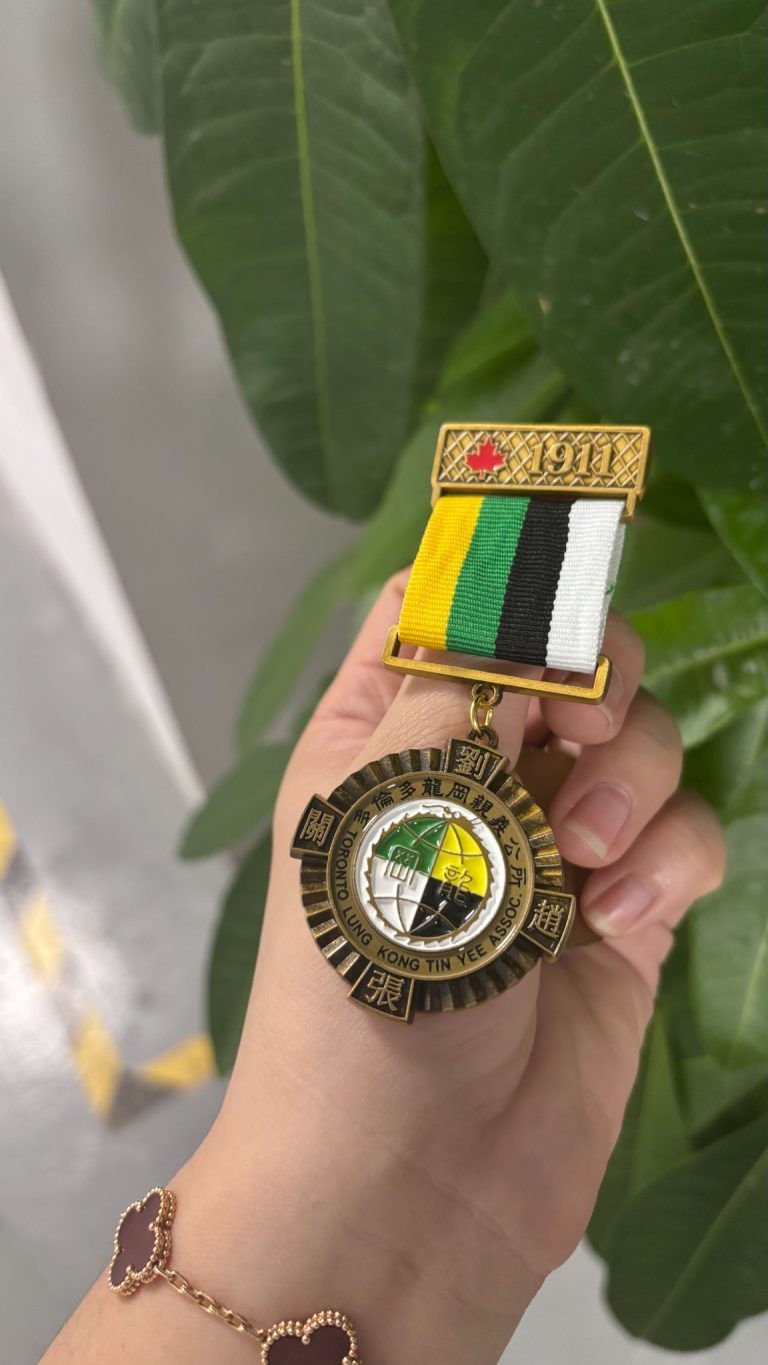
The fourth photo shows the finished physical sample.
At this stage, you can see how the original idea translates into an actual product. The antique gold-coloured metal finish brings out the raised details, while the enamel colours and striped ribbon complete the design.
Before starting a larger production run, we photograph and film the sample so the customer can review the overall appearance.
We check the metal finish, lettering, enamel colours, ribbon attachment and general workmanship. If anything needs attention, it’s much better to address it at the sample stage than after hundreds or thousands of pieces have been produced.
Image caption: The completed custom medal sample with an antique gold finish, coloured enamel and a four-colour ribbon.
4,Custom Medal Colors and Finishing Options
Color is an important part of custom medal design, and we have several ways to achieve the look you want.
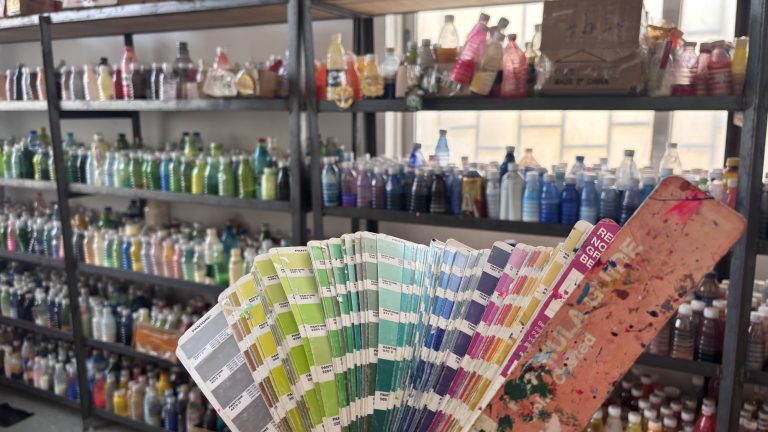
For traditional enamel medals, we mix colors according to Pantone references. Our factory keeps a wide range of enamel paints, allowing us to match brand colors, event logos, and other specific color requirements.
But traditional enamel isn’t the only option. We also offer translucent enamel, glitter, pearlescent finishes, glow-in-the-dark colors, and full-color UV printing.
Full-Color Printing for Detailed Medal Designs
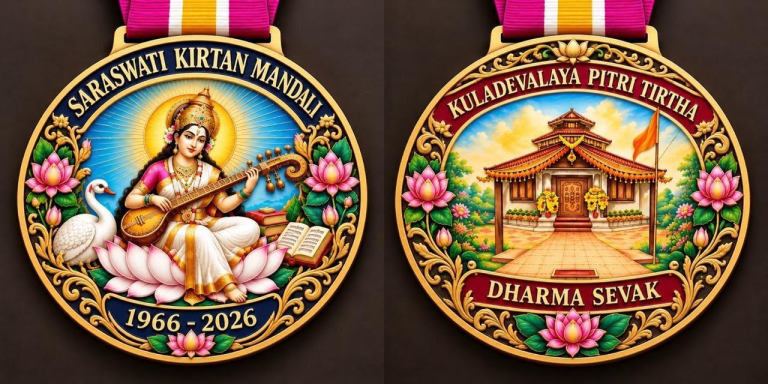
UV printing gives us much more flexibility with complex artwork. We can print portraits, buildings, flowers, shadows, and smooth color gradients without separating every detail into individual enamel sections.
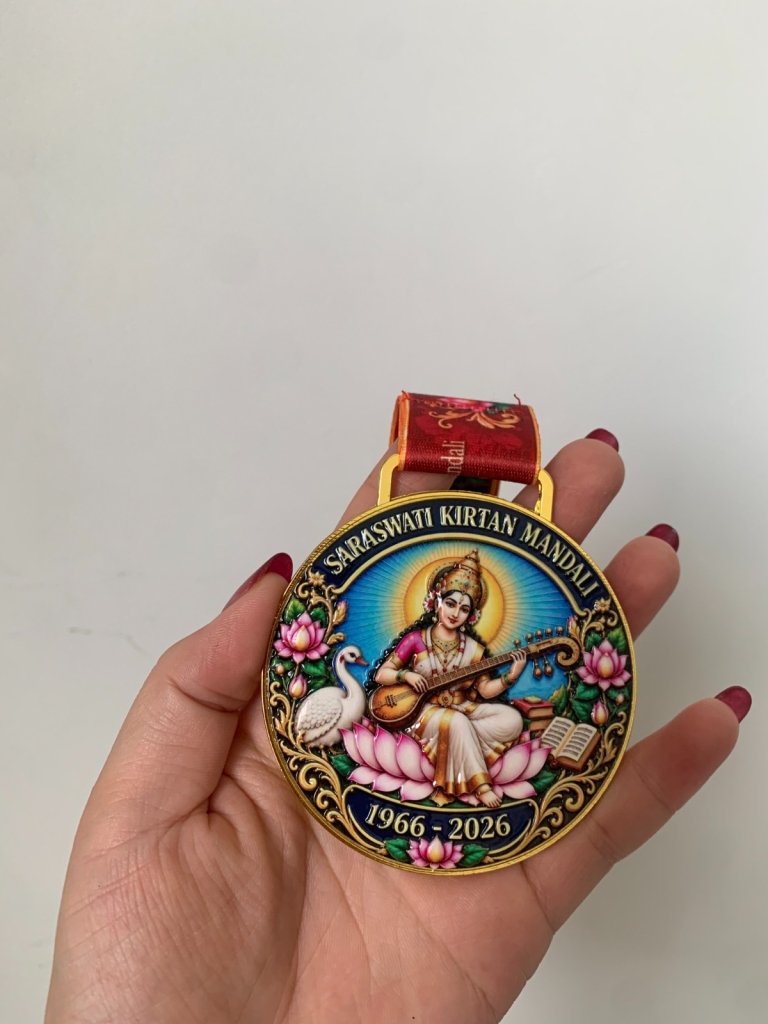
The medal shown here is a good example. The original artwork features Saraswati on one side and a temple on the other, with detailed illustrations and many different colors.
We used full-color printing together with raised metal details and an antique gold-style finish. Comparing the original design with the finished sample shows how closely the artwork can be reproduced on a metal medal.
We can also work with AI-generated artwork. If you have a design made with AI, you can send it directly to us. We’ll check the details and recommend the best way to produce it.
For projects where color accuracy matters, we recommend checking a physical sample before mass production. Printed colors can look slightly different from what you see on a screen, particularly when combined with metal finishes.
Conclusion
Successful medal customization relies on smart material choices, clear communication with your designer, and understanding how color and plating affect the final product. Use this guide to make informed decisions and create medals that are both beautiful and durable.
The Most Complete Guide to Custom medals for 2025-2026


8 process for made lapel pins and medals
8 process for made lapel pins and medals.Do you know which crafts are used to make lapel pins and medals? Different processes have different effects on your design draft. How to present your design endlessly?

Materials for making marathon medals
This article is an introduction to the materials used to make marathon medals. We introduce the advantages and disadvantages of different materials from multiple dimensions.

Metal plating colors
Perhaps you don’t know much about the process of custom medals. This is the ultimate guide to platting of custom medals

What is the purpose of medals?
Winning MEDALS in science and technology, sports events, schools and other fields is the recognition and reward of one’s own ability and effort, which can realize one’s personal value and gain a sense of feet.

What is price of medal?
What is price of medal?Are you troubled by the price of medals and don’t know how to choose a supplier?
Today’s article will tell you the tips for ordering medals and save you 35% of the cost.

OEM medal custom factory
OEM medal custom factory Are you looking for a factory that meets your expectations?
Shenzhen Yuehui gifts Co., Ltd. is a professional medal production experts. We have been in the field of medal making for 11 years.
Since its establishment, we have continuously improved the level of production technology. Now we have become an excellent OEM medal custom factory in China